Yesterday was Aduge’s 3rd birthday!!!
-
RSS Feeds
-
Categories
-
Archives
 English
 Português
Last time I spoke briefly about the Tsar Project’s themes of aloneness and patience and how they are thought to be integrated with the gameplay and other aspects of the game. Now it’s time to talk about the gameplay itself, more on general terms rather than on specific details. What it means is that I will talk about how the game will be played/experienced on a general level, trying to not spoil too much of the experience proper.
To begin with, Tsar is an infiltration mission. The protagonist is an outsider, an invisible summoned creature inside the heavily guarded and tense Moscow Kremlin Palaces. A mission is presented, but it hardly matters, the character is where it shouldn’t be, and there are people that will attack anything that don’t belongs there. Thus, the game objective is quite clear: avoid all guards, civilians, animals (read: everyone) and reach your destination within a set time limit. Failing to elude the obstacles means a very hard time for the player, or simply failing the game itself.
And what means this character has to complete its objective? As said above, it is an invisible creature. No human can see it under normal conditions. Although particles, debris, snow, blood or and any other mundane object over this creature’s body remains visible. So it’s for the best to avoid getting dirty. And even if invisible, the character still makes sounds which can be heard by any attentive guard, so silent movements are still important. Also, the protagonist (it’s name shall remain a mystery, for now) is very athletic and agile, being capable of exploring the environment with great mobility. Now it may seems pretty easy, right? Not that much. There’s one major vulnerability in this playable character that enforces the game as a “sneaking mission”. The protagonist is fragile. Fragile to the point that any wound can mean it’s death. A direct combat situation is extremely adverse to the player and even if this character is powerful enough to kill or incapacitate most humans in one single strike, this kind of situation remains a risky gamble that should be avoided.
Another interesting aspect of the game is related to it’s time limit. The player has one in-game night to complete the mission. All characters (and I mean all of them) that inhabit the Moscow Kremlin have their routines and their stories on this particular night, as the time progresses. The player can simply watch everything or take action and see the results, whichever he wants. Guards will stand watch, workers will do their jobs, everyone will sleep, eat, or do whatever else people do. There is also a behavior system which conducts every character’s actions and reactions that will result in a very complex AI system, where enemy characters will not be as dumb as players are used to.
To sum it up, the Tsar Project is a stealth game where the player must elaborate routes and actions that are the most efficient to reach a destination without being seen or raising suspicions. Killing guards seems easy, but it’s not a very good idea most of the time (as it can cause a full scale alert, locking paths and whatnot) or going the most obvious and guarded route is not as efficient as using other sneaky and more subtle paths. When playing Tsar, remember: you are invisible, you are alone, you are deadly, but you still breath and is mere flesh and blood as any other. Better tread carefully.
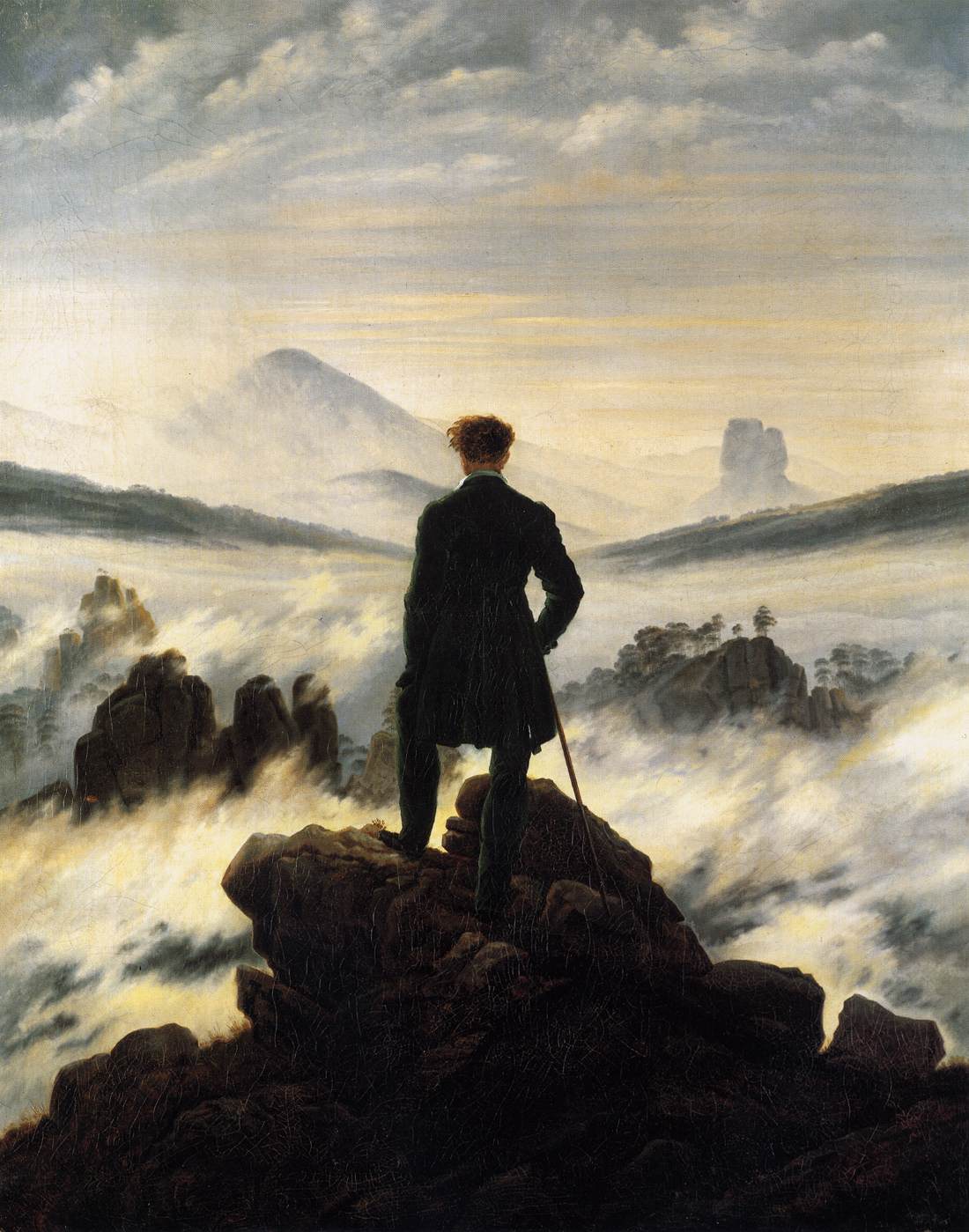
Wanderer above the Mists - Caspar David Friedrich
So, we said we have a new project. We even posted a production update of it. But… we still didn’t present it properly did we? Well, let’s correct that. Presenting: Tsar Project.
Most people upon contact with a new game simply ask “what kind of game is this?” and are satisfied by the fairly superficial answer. Simply put, Aduge’s current project is a challenging stealth game set on XVI century Russia. We could go on and on about the game’s mechanics and features, but this wouldn’t present Tsar Project more than it’s outermost layer. To most players this would do, but the target audience of our studio isn’t most players. When it comes to Aduge’s projects the more correct question we’d like to hear is “what is this game about?”. This type of question let us explain why Tsar Project is a challenging stealth game set on XVI century Russia which is the heart of the “problem”, so to speak.
Now, getting finally to the point of this post: Tsar Project as a game is about aloneness and patience. It’s not just a story about aloneness and patience, it’s a game about these concepts. This means that the game itself through it’s mechanics and challenges deals with these concepts.
Aloneness not in the sense of loneliness, but in the sense of distancing an individual from a group, up to the point he becomes a complete outsider. In Tsar’s case, the player will be immersed on the main character’s mind which is alien to the universe of the game itself, hence the feeling of aloneness. Other supernatural traits of this main character contribute to the distancing and the feel of aloneness, but the nature of these traits we leave to another opportunity.
This is a game about waiting and that is what makes it difficult in the first place. The more reckless or hasteful the player is, the more mistakes he will eventually make and this will compromise his/her task. It’s a true stealth game, where active push and aggressive behaviors end up biting the player’s hand in the long run. Waiting, contemplating, looking for patterns, reading behaviors, these are actions that rewards the player more than his skill at pressing buttons at the right time.
That being said, this is only the conceptual guide that drives the game development and design. But that is not the “right” meaning of Tsar Project and we still encourage players to play and interpret the game the way they want to. See you next post!
March 2009: Aduge starts developing it’s new game, code-name Tsar Project.
April this year: We move to our new headquarters in the Azuri Building
May: The studio turns 2yo.
July: The Adugans buy an espresso machine
September: Still no welcome party? How can it be???
Not anymore. One week ago, on September’s 8th, the so long waited Aduge’s Coffee Party took place in the three rooms of the Azuri Building currently used by the studio; being them the Headquarters Proper, Sun’s Bedroom and The Kitchen. We’ve had some of our closest friends, many types of special Brazilian coffee grains, and obviously, games.
Ingrid and Marcel competently took the charge of coffee tenders, and, among normal espressos and cappuccinos, prepared some interesting variants such as machiattos, nutella mochas and our exclusive brigadeiro coffee. We had breads, pies, cakes and snacks provided by our beloved guests. And for the games, N64′s Super Smash Bros. and Mario Tennis and CPS3′s Street Fighter 3 Third Strike (tough we don’t have a proper CPS3 machine, yet, we do the best we can with an emulator). The most remarkable challanges were undoubtedly the 4 players Smash Bros. ones.
We would like to thank our amazing guests and certify you that it was a real pleasure and reason of great happiness to us all to see you around here, so,come back soon! And for those that haven’t visited the studio yet, be sure, we are awaiting your visit!